
I sat down with a retired CEO last month. Ninety minutes over coffee. No agenda, no survey, just a cultural conversation around: Tell me what it was really like.
Forty minutes in, they stopped mid-sentence.
“Never talked about this before.”
What followed wasn’t a polished case study. It wasn’t about transformation programs or strategic frameworks. It was about the small, quiet moments that revealed the real culture.
On Monday mornings, when nobody spoke about the values poster, they walked past every day without looking.
The good people who left, one by one, and how he knew exactly why but couldn’t say it out loud at the time.
Now they could. Because they didn’t have to protect their career anymore.
That’s the power of honest conversation, and that’s why I’m doing this, not for six months, but for the next 20-25 years.
What Cultural Conversations is
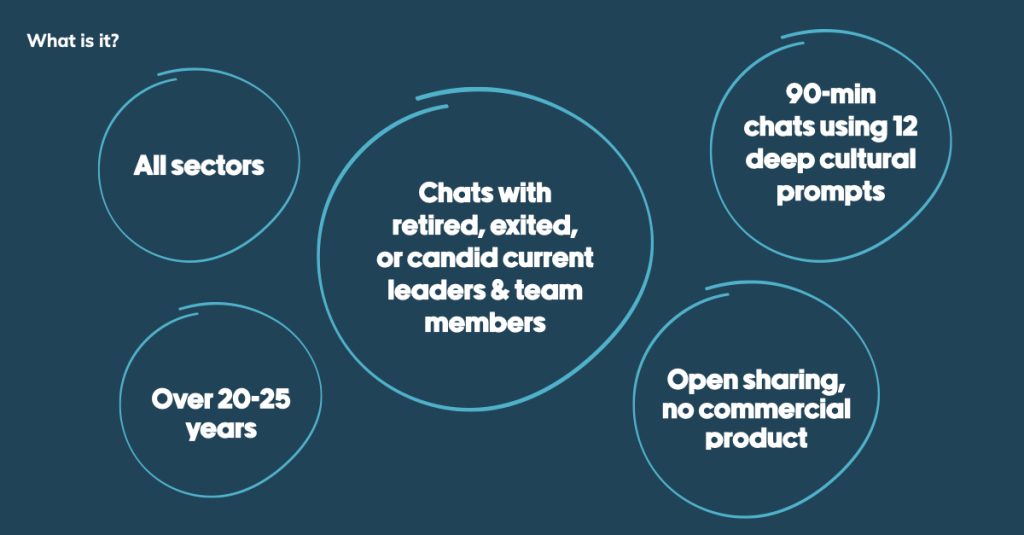
It’s a long-term project to build an archive of how humans really experience work, across every sector, as technology reshapes the world around us.
The format is simple, 90-minute conversations over coffee (or virtually). With leaders, board members, founders, team members and anyone who’s spent years inside organisations.
Whether you’ve retired, exited, or are still working, then you can speak honestly, you’re who this project needs.
The approach is guided by 12 deep-rooted cultural prompts designed to surface the truth about how work really feels.
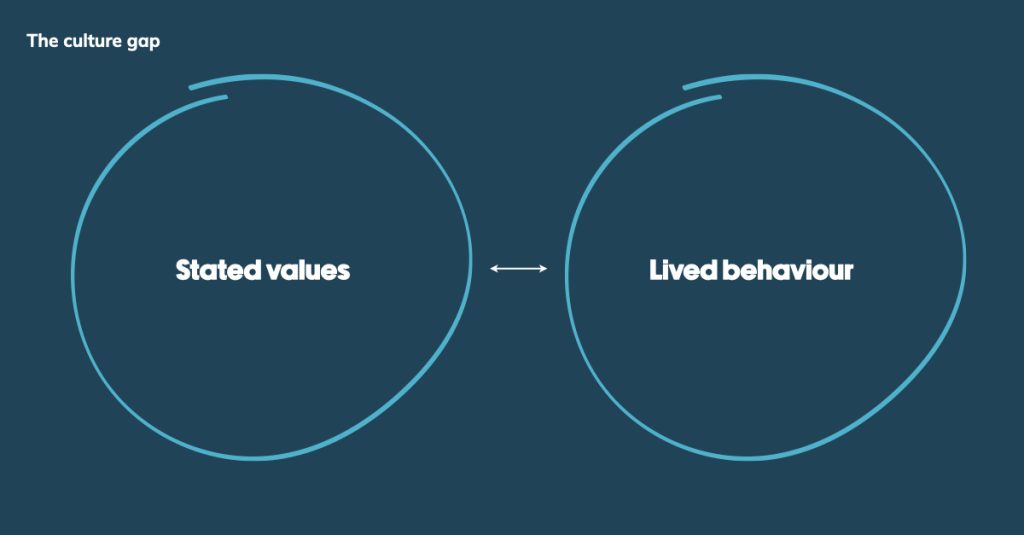
These aren’t generic questions. They’re designed to open up the unguarded reality, the gap between what companies say and what people actually experience.
The commitment is that every conversation gets recorded and transcribed. Nothing gets published without sign-off. Some people want their names used. Others prefer anonymity. Both work.
This isn’t a sprint. It’s a 20-25-year commitment to understanding how culture evolves as the world around work changes.
Why it matters
After years of seeing cultures from the inside out, here’s what I know:
The best insights don’t come from surveys. They come from honest conversations with people who can speak freely.
Retired CEOs. Founders who’ve exited. Leaders still in post but willing to be candid. Team members who’ve seen it all firsthand.
Current employees filling out engagement surveys? They’re careful. They hedge. They know HR is watching.
But someone who can speak without consequence? They’ll tell you the truth.
And when you listen to enough of those truths, across agencies, charities, commercial businesses, public sector organisations, creative industries, tech startups and patterns emerge.
- The gap between stated values and lived behaviours shows up everywhere, regardless of sector
- Leaders underestimate how much their own behaviour shapes culture
- The best cultures aren’t the ones with fancy values statements — they’re the ones where people genuinely feel seen and safe
- Small rituals matter more than big transformation programs
- Trust breaks faster than it builds
These aren’t new insights. But hearing them in real voices, across industries, over decades, that’s where depth lives.
Why nobody else is doing this
I have huge respect for the work that Culture Amp, Gallup, Gartner, McKinsey, Hofstede, and the GLOBE study have done. They’ve shaped how we think about culture and leadership globally.
But here’s what they’re built on and why Cultural Conversations is different:
Culture Amp: 5-50 question surveys (5-10 minutes, quarterly). Platform built on dashboards, not decades of conversations. (Source)
Gallup: Q12 workplace audits with focus groups. Millions surveyed, but still primarily quantitative. (Source)
Gartner: Surveys 18,000+ workers tracking metrics. Survey-based, not individual stories. (Source)
McKinsey: 7S model with surveys and interviews, tied to consulting engagements. Not independent longitudinal research. (Source)
Hofstede: Surveyed 100,000+ IBM employees in the 1970s. Quantitative factor analysis, not qualitative life stories. (Source)
GLOBE Study: 17,300 middle managers, 62 countries, 735-item questionnaire. Groundbreaking scale, still survey-based. (Source)
What none of them are doing:
✗ 90-minute in-depth 1-2-1 interviews using deep cultural prompts
✗ Cross-sector longitudinal research over 20-25 years
✗ Conversations with retired leaders, exited founders, and current team members who can speak candidly
✗ Open sharing without paywalls or commercial platforms
That’s the gap Cultural Conversations fills.
What makes this unique
| Dimension | Others | Cultural Conversations |
| Format | Retired, exited, or current candid leaders & team members | 90-minute guided conversations with 12 deep cultural prompts |
| Timeline | Quarterly/annual cycles | 20-25 years longitudinal |
| Who | Current employees (guarded) | Retired, exited, or candid current leaders & team members |
| Scope | Specific industries or client work | Every sector, independent research |
| Access | Paywalled platforms or gated research | Open sharing, no commercial product |
| Method | Quantitative surveys + limited qualitative | Entirely qualitative, conversational |
How you can get involved
If you’re a leader, founder, board member, team member, or someone who’s spent years inside an organisation and has a story to tell, I’d love to hear it.
What’s involved: One 90-minute conversation over coffee (or virtually). 12 deep cultural prompts to guide the discussion. Recorded and transcribed. Nothing gets published without your sign-off.
What’s in it for you: A chance to reflect on your career, share what you’ve learned, and contribute to a long-term body of work on how humans experience culture at work.
How it works: Get in touch via hello@chrisdowdall.com or via LinkedIn.
We’ll find a time that suits. No preparation needed, just your honest experience.
FAQs
Q: Is this academic research?
No. It’s a practitioner-led project grounded in real experience, not a formal academic study.
Q: Do I need to be retired to participate?
No. You can be retired, exited, or still working. The only requirement is that you can speak honestly about your experience.
Q: Will my name be used?
Only if you want it to be. You can choose to be named, anonymised, or remain completely confidential.
Q: What are the 12 deep cultural prompts?
They’re designed to surface the truth about how work really feels, the gap between stated values and lived experience. They’re not generic questions; they dig into the moments that reveal culture.
Q: What sectors are you focusing on?
All of them. Agencies, charities, public sector, commercial businesses, creative industries, tech, anywhere humans work.
Q: How is this different from a podcast?
Podcasts are performance. This is a conversation. The goal isn’t polished content, it’s unguarded truth captured over time.
Q: What will you do with the insights?
Share them openly in posts, articles, talks, and eventually a book. The aim is to build collective understanding, not sell a platform.
Q: Why 20-25 years?
Because culture doesn’t change overnight. Technology is accelerating, but human dynamics take time to shift. This project captures those shifts as they happen.
Ready to share your story?
Culture isn’t fixed in workshops or away days. It’s built in the small moments. The daily habits. How people feel walking in on a Tuesday morning.
This project is about capturing those moments, over decades, across sectors, so we can finally understand what actually makes cultures work.
If you’ve got a story, let’s talk.

Ready to explore your best route? Take the ten-minute culture quiz. Or book a call and let's have a wee chat on how to move forward together.