

The Matrix got the drama wrong, but it got one thing bang on.
I watched The Matrix again this week with my daughter.
She’d never seen it before and couldn’t believe it was from 1999, way before she was born.
I’d forgotten how brilliantly ridiculous parts of it are, but how back then we thought it was way cool
From the leather trench coats, the really really strange tiny sunglasses, the slow-mo action scenes, to the mix of old-tech landlines with amazing never-before-seen flip phones (it was back then).
But one scene sticks with me, and for those who haven’t seen it, check it out.
Do you take the blue pill or the red pill?
The blue pill makes you stay comfortable and carry on as you are.
The red pill makes you see the world as it really is.
It’s probably one of the most iconic moments in cinema, or maybe in my eyes.
Back in 1999, the movie imagined machines taking over humanity, and people either had to wake up or become slaves to them.
Watching it now, I don’t think that’s the real choice anymore.
AI isn’t arriving with killer robots.
It’s arriving by writing meeting notes, summarising Teams calls and answering emails.
I know that’s much less cinematic but it’s far more believable.
Last week, Mark, who I work alongside at Marketing Mavens, condensed a team client reporting document from 4 hours to about 30 minutes.
That included the human reviewing and adding the care while AI did the heavy lifting.
That’s brilliant.
But the interesting bit wasn’t the technology, it was what happened afterwards.
The conversation wasn’t about how much more work we could cram into the day.
It quickly became about what everyone could do with the time it’d just created.
That feels like the real red pill moment.
Because AI isn’t just giving us efficiency, it’s giving us choices.
You could fill those hours with more meetings, or more admin and output.
Or…
You could finally have that proper catch-up you’ve been putting off.
Maybe coach someone who’s struggling or mentor the graduate who keeps doubting themselves.
Check in with the quiet person who’s stopped contributing in meetings but actually listen.
That’s when I realised something.
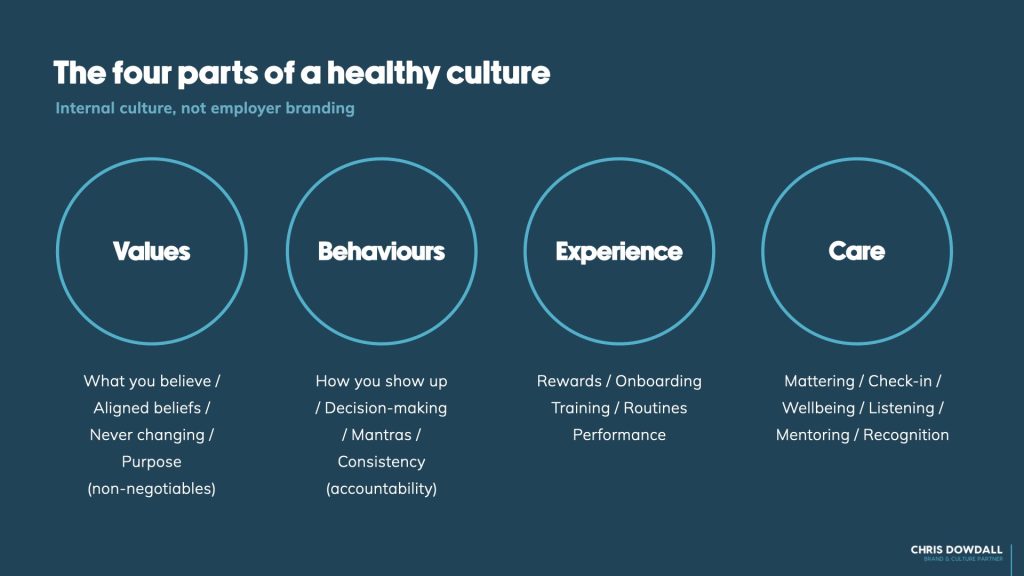
For a while now I’ve been thinking about culture through four simple lenses.
Values, behaviours, experience and care.
Most organisations already spend time talking about the first three.
The fourth is the one I think becomes even more important as AI becomes part of everyday work.
Care
It’s not care as a slogan, or a wellbeing week.
I mean the everyday stuff.
The check-in that isn’t on the calendar.
The 5 min conversation that stops someone leaving, maybe you called it the watercooler chat?
The recognition that isn’t tied to a bonus.
The mentoring session instead of another dashboard review.
I’ve worked with leaders who treated every efficiency as another opportunity to squeeze more output from folk.
I’ve also worked with leaders who saw efficiency as permission to invest back into their team.
Same technology, yet completely different leadership.
Everyone’s asking whether AI will replace jobs but I’m more interested in what it replaces us doing.
If AI writes the first draft, summarises the meeting, builds the presentation, and answers routine questions, then what are we choosing to do with the time it gives back?
Because if the answer is simply “more work”, we’ve probably missed the opportunity.
Maybe that’s the real choice facing leaders, whether to use AI to squeeze every drop of productivity from people or use it to create more time for the conversations only humans can have.
That’s become part of how I think about culture.
Whether people genuinely feel cared for when all the busy work disappears.
If it gave your team a few hours back this week, what would they do with it?

Ready to explore your best route? Take the ten-minute culture quiz. Or book a call and let's have a wee chat on how to move forward together.